Labrador Retriever Essentials
How to Socialize a Labrador Puppy
The window is short, the stakes are high, and it starts before your puppy ever comes home. Here is how we do it, and how you carry it on.
Home › Labrador Retriever Essentials › Socializing Your Labrador Puppy
Most people worry about the wrong thing with a new puppy. They worry about parvo. They should worry about behavior.
Behavioral problems, not disease, are the number one cause of death in dogs under three years old, and the number one reason dogs end up surrendered to shelters. The fix is socialization, and the window to do it is short. With a Labrador puppy, the clock is already running.
Here is the good news. Socializing a Labrador puppy is not complicated, and Labs are wired for it. They want to like people and other dogs. Your job is to show them the world while they are still young enough to take it in stride.
Behavioral problems, not infectious disease, are the leading cause of death in dogs under three years old, and the top reason dogs are surrendered to shelters. Source: AVSAB Position Statement on Puppy Socialization
The Window: Why Timing Is Everything
A puppy's brain has a specific window when it is built to accept new things without fear. The American Veterinary Society of Animal Behavior puts the primary socialization period in the first three months of life, roughly 3 to 14 weeks. During that stretch, curiosity outweighs fear. A puppy that meets a child, a vacuum, a man in a hat, and a friendly older dog during those weeks files them all under normal. The same puppy meeting them for the first time at six months may decide they are threats.
is the primary socialization window, the period when a puppy's curiosity outweighs its fear. Miss it and you cannot fully get it back later. Source: AVSAB
Why so early? Because the risk of a behavior problem from missing the window is far greater than the small disease risk in those weeks. That single idea should reshape how you think about your puppy's first months.
is when AVSAB says puppies should start socializing, before they are even fully vaccinated. They call early socialization the standard of care. Source: AVSAB
Birth to 8 weeks
With us. Daily handling, our grandkids, the rest of the pack, and the noise of a busy household.
8 to 14 weeks
With you. The critical window, and the most important weeks of work you will ever do with your dog.
14 weeks and on
The window narrows. Keep socializing, but the foundation is largely set by now.
It Starts Before Your Puppy Comes Home
Here is what most buyers never think about. A Lab goes home around eight weeks, which means the first half of that critical window happens under the breeder's roof. What we do in those eight weeks is a head start no pet store gives.
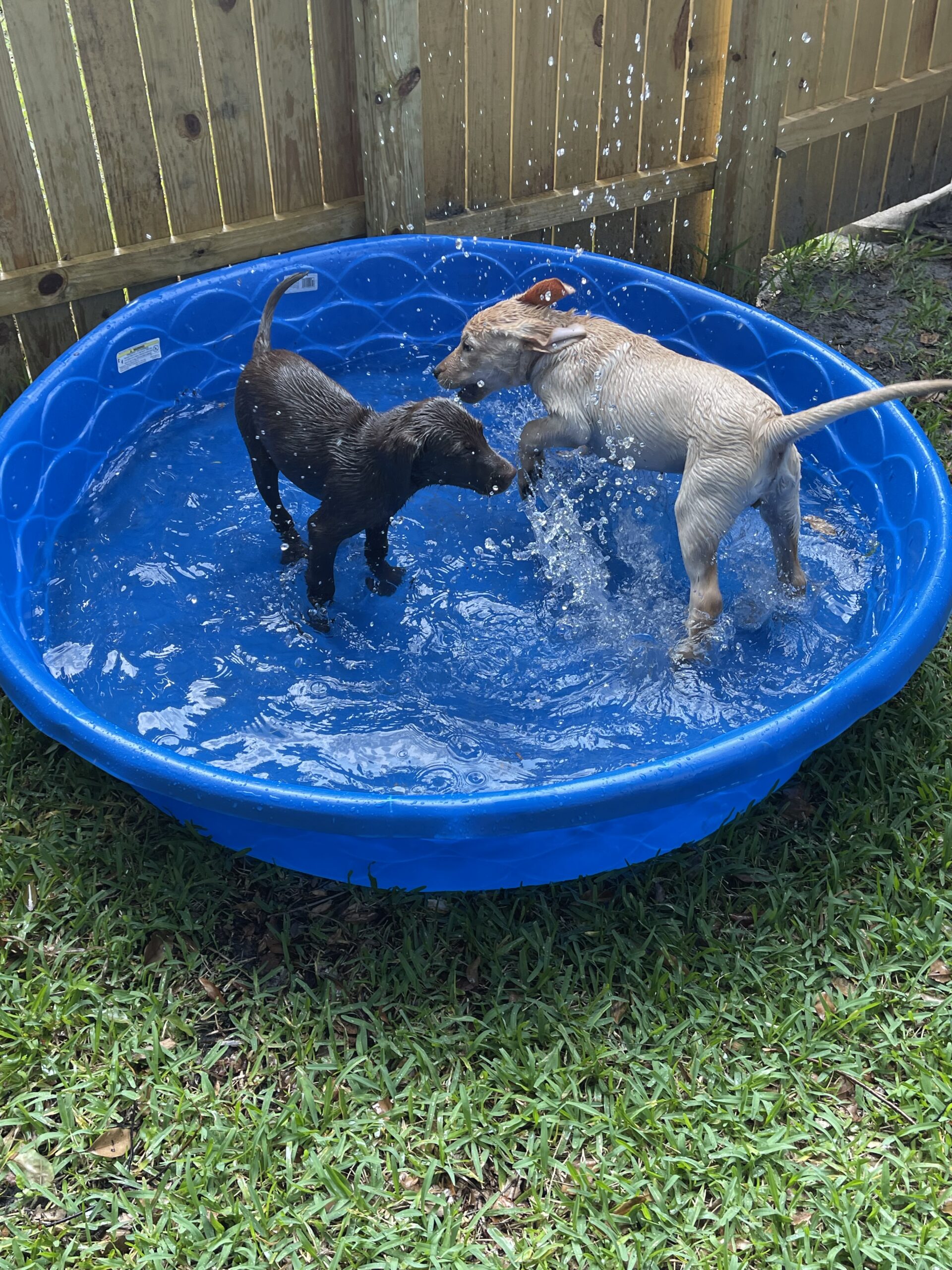
We are hands-on from the minute they are born. We pet them, carry them, and play with them every day, so being handled by people is the most normal thing in the world to them. Our grandbabies start playing with the puppies at around two weeks, so kids are part of life from the start. At about six weeks we bring them around our older dogs, who do half the teaching for us. A puppy learns dog manners fastest from grown dogs that will not put up with nonsense.
We also start crate training at six weeks, which I will come back to, and we keep the puppies inside until they have had their first shots at eight weeks. After that, the world opens up. The first trip outside is a big moment.
One of Luna's puppies heading outside for the very first time. Dr. Paul Borosky, DBA, MBA, Borosky Labradors.
There is a real payoff to raising puppies in a crowd. Take our last two litters, born on the same day. We raised them side by side and brought the puppies together after their second week, so they grew up surrounded by other dogs. The result showed up in the homes. One of our buyers, J. Jacob, took her puppy home to an older dog who had lost his companion a few months earlier. The two were friends on day one. A puppy raised around other dogs from week two already knows how to be one.
Your Job: Weeks 8 to 14
When the puppy comes home, the baton passes to you, and these are the weeks that matter most. The goal is simple: positive, bite-sized exposure to as much of the world as you safely can. Keep every session short and upbeat. End on a good note. Let the puppy explore at its own pace, and reward calm, brave behavior with praise and a treat. Never flood a puppy by forcing it into something overwhelming. That backfires and can create the exact fear you are trying to prevent.
Use this as your checklist. Work through as many as you can, calmly and positively, before fourteen weeks.
Your Puppy Socialization Checklist
- People. Men, women, and children, plus hats, beards, uniforms, wheelchairs, and canes.
- Dogs and animals. Calm, vaccinated adult dogs, other puppies, cats, and any other pets.
- Sounds. Vacuum, doorbell, traffic, thunder, and fireworks played at low volume.
- Surfaces. Grass, tile, gravel, metal, stairs, and wet ground.
- Places and handling. Car rides, the vet lobby, and having paws, ears, and mouth touched, plus nail trims and baths.
A note on nipping, because every Lab puppy does it. We treat it the way a littermate would. A sharp "ow" tells the puppy it bit too hard, then we redirect to a chew toy. Calm behavior gets attention and play. Rough mouthing makes the fun stop. And we never pick a puppy up while it is jumping or climbing, because that just teaches it that jumping works.
On the crate: keep it up, and start early like we do at six weeks. The crate is not a cage, it is the puppy's safe spot, the place it goes to settle and feel secure. A puppy with a den is a calmer, more confident puppy. Use it. We go deeper into housebreaking and manners in our guide on Labrador puppy training, and cover the whole first-weeks routine in Labrador puppy care.
Learn to Read Your Puppy
Socialization goes wrong when an owner misreads the dog and pushes too hard. Learn the signals. A loose, wiggly body, a play bow with the front end down and rear up, and a soft open mouth all mean the puppy is comfortable and having fun. A tucked tail, flattened ears, yawning, lip licking, or the whites of the eyes showing mean the puppy is stressed and needs space. If you see the stress signs, calmly create distance and try again later, smaller. You are never trying to win a standoff. You are building trust. There is more on what drives these reactions in our guide to Labrador behavior and temperament.
Out in the World
Each setting has its own lesson. On walks, reward your puppy for calmly noticing other dogs and people instead of lunging or fixating. At the vet, turn the lobby into a place of treats and gentle attention so the clinic never becomes scary. With guests, teach a simple sit to say hello, so your Lab greets people with manners instead of a seventy-pound hug. Practice the calm version over and over and it becomes the default.
When Your Puppy Is Shy or Scared
Some puppies are bolder than others, and that is fine. If yours is cautious, go slower and keep the wins small. Never force a frightened puppy into anything. Let it approach on its own terms and reward every brave step. If you see real, persistent fear or any aggression, do not wait it out. Bring in a qualified positive-reinforcement trainer or a veterinary behaviorist early, while the puppy is still young enough to change course easily.
Raised Right From Day One
Our puppies start socializing the minute they are born. That is the Borosky difference.
References
- American Veterinary Society of Animal Behavior (AVSAB). "Position Statement on Puppy Socialization" (socialization window, behavioral issues as the leading cause of death in young dogs, early-socialization standard of care). avsab.org