Labrador Retriever Essentials
Understanding Your Labrador's Behavior and Temperament
The food obsession, the velcro loyalty, the smarts, the stubborn streak. It is all working-retriever wiring. Here is what is really going on.
Home › Labrador Retriever Essentials › Behavior and Temperament
A Labrador's behavior can look random until you understand one thing: a Lab is a working retriever's brain in a family dog's body.
Everything the breed does, the food obsession, the velcro loyalty, the mouthiness, the smarts, the occasional stubborn streak, traces back to what these dogs were built to do. Understand the wiring and your Lab stops being a mystery. You learn to work with the dog instead of against it. We live with six of them, and no two are the same. Here is what is really going on behind that goofy grin.
Bred to Work With People
Labradors were developed to work side by side with a handler, retrieving game and waiting on direction all day. That history is why your Lab is so focused on you. It is why the breed is the number one choice for guide, service, and search-and-rescue work the world over. They are wired to take cues from humans and to want a job.
of 131+ breeds for working and obedience intelligence, per Stanley Coren. That puts the Lab in his top tier, learning a new command in fewer than five repetitions and obeying a known cue on the first try about 95% of the time. Source: Stanley Coren, The Intelligence of Dogs
That intelligence and people-focus is why Labs train up so well. It is also why a Lab that gets ignored all day invents its own job, usually one you will not like. We dig into how to channel that in our guide on Labrador puppy training.
The Food Brain
If your Lab acts like it is starving five minutes after dinner, it is not lying to you. It is built that way. Around a quarter of Labs carry a variant of the POMC gene that blunts the feeling of being full. The famous Lab appetite is partly hardwired, and it drives a lot of behavior: the counter-surfing, the begging, the vacuuming of crumbs off the floor, the willingness to eat things that are not food.
of Labs carry the POMC gene variant tied to constant hunger and food motivation, found almost only in Labs and Flat-Coated Retrievers. Source: University of Cambridge
The upside is huge for training. A food-motivated dog is an easy dog to teach, because the paycheck always works. The downside is you have to manage the environment. Do not leave food on the counter, and do not free-feed. We cover the discipline side in common health problems, since that same drive is why Labs are so prone to obesity.
The Velcro Side
Labs bond hard. They will follow you from room to room, settle at your feet, and wait by the door until you come back. Our Emmie is the poster child. She is Dr. Paul's shadow, and she is not happy unless she is touching him. That devotion is one of the best things about the breed.
It has a flip side worth knowing. A dog this attached can struggle with being alone if you never teach the skill. Build short, calm alone-time into your puppy's routine early so the attachment stays healthy and never tips into full separation anxiety. The crate helps here, and so does early independence. More on that in our socialization guide.
The Smarts and the Mischief
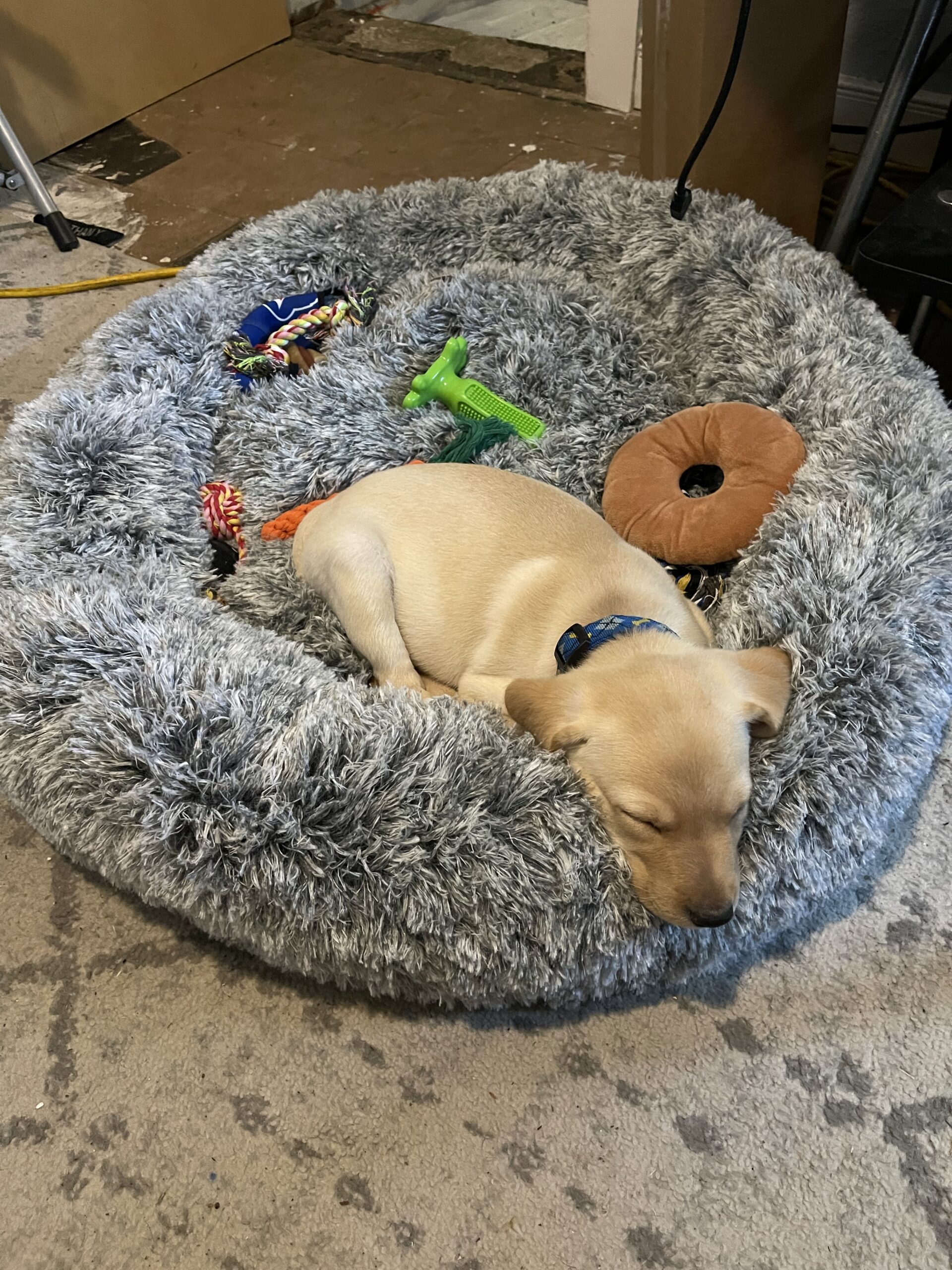
Here is the part people underestimate. A smart dog is a handful. That same intelligence that makes Labs easy to train makes them excellent at causing trouble when bored. They figure out latches, open doors, and problem-solve their way into anything interesting. Our Dunkin has his own quirk. He collects. Toys, chews, whatever he can carry, all gathered into one pile that is very much his.
Just how smart is a Lab? Here is where the breed lands against a few others, based on Stanley Coren's intelligence rankings.
Labrador Intelligence vs Other Breeds
An illustrative 0 to 10 score based on Stanley Coren's working and obedience intelligence ranking of 131 breeds. It measures trainability, not overall cleverness. A Husky is plenty smart, just independent.
Score derived from Stanley Coren's breed ranking. Illustrative, not an official IQ test.
The takeaway is not that other breeds are dumb. It is that Labs are wired to learn from people fast, which is exactly why a bored one runs circles around an unprepared owner.
None of this is bad behavior. It is an under-stimulated brain looking for work. The answer is never just more yard time. It is mental work: training sessions, puzzle feeders, new places, and jobs to do. A Lab that gets its brain tired is a calm Lab. We get into the physical side in exercise needs.
The Teenage Phase Nobody Warns You About
Your sweet, obedient puppy will, at some point, seem to forget everything you taught it. This is real, and it is documented. Research published in Biology Letters found that dogs hit an adolescent phase around eight months, roughly the six-to-twelve-month range, when they become noticeably less obedient. And here is the kicker: the disobedience is aimed specifically at their primary person. The same dog will still behave for a stranger.
is the peak of the canine "teenage" phase, when a dog is least obedient to its main caregiver, then grows out of it. It is also when many dogs get surrendered. Source: Asher et al., Biology Letters, 2020
One of our puppies out for a stroll in the Florida sunshine. Dr. Paul Borosky, DBA, MBA, Borosky Labradors.
We see our own version of this. Our English girls, after weeks of being solidly house trained, have backslid around sixteen to eighteen weeks and started having accidents in the house again for a couple of weeks. The first time it happens, it feels like you broke your dog. You did not. It is a developmental phase. We go back to basics, stay consistent, and it passes. The worst thing you can do during adolescence is punish hard or emotionally check out. That is exactly when a lot of dogs get surrendered, right when they need patience the most. Ride it out and your good dog comes back.
| What your Lab does | What is behind it | What to do |
|---|---|---|
| Counter-surfing, stealing food | The POMC food drive | Manage the counters, never free-feed, reward "leave it" |
| Follows you everywhere | Deep attachment to its people | Normal and healthy; build alone-time skills early |
| Suddenly ignores you around 8 months | The adolescent phase | Stay calm and consistent; do not punish or quit; it passes |
| Chewing, digging, zoomies | Boredom and unspent energy | More exercise and mental work |
| Mouthing, carrying things | Bred-in retriever instinct | Redirect to a toy or a job |
| Backslides on house training | A developmental regression | Go back to basics for a couple weeks; consistency wins |
Every Lab Is a Little Different
Breed wiring sets the defaults, but personality is individual. Our six make the point.
- Louie: sharp and sweet, with a serious case of selective hearing.
- Remi: the brains of the house, independent, obeys on her own terms.
- Dunkin: confident, easygoing, and the official toy collector.
- Sadie Mae: calm, gentle, and steady.
- Emmie: pure velcro, Dr. Paul's shadow.
- Luna: the mellowest of the bunch, sweet to the core.
Same breed, six different dogs. When you understand the wiring underneath, you can meet your own Lab where it is, and that is where the real bond gets built.
Want a Lab Raised by People Who Get Them?
We have lived with this breed for years, and it shows in how our puppies turn out.
References
- Coren, Stanley. The Intelligence of Dogs (working and obedience intelligence ranking). stanleycoren.com
- University of Cambridge. "Genetic variant may help explain why Labradors are prone to obesity" (POMC food motivation). cam.ac.uk
- Asher L, England GCW, Sommerville R, Harvey ND. "Teenage dogs? Evidence for adolescent-phase conflict behaviour..." Biology Letters, 2020. Royal Society